Why Forged Wheels Crack at the Spoke Root, and How to Design It Out
Forged wheels that crack in service usually crack at a spoke root, fork or bridge. Two road failures, replayed blind in FEA, show why and what designers can change.
Why the spoke root carries the most stress
Treat a spoke as a beam fixed at the hub. Every load from the tyre, whether cornering, braking, acceleration or a pothole, acts on the far end of that beam. The bending it produces is smallest near the rim and largest where the spoke joins the hub, or where two spokes merge into a fork. That junction is the spoke root, and three things work against it at once.
The lever is longest
Bending moment grows with distance from the load. The root carries the full lever of the spoke, so it sees the highest bending stress anywhere along the arm.
The section changes quickly
A slim spoke running into a thick hub, or two spokes merging into one, forces the load to change direction over a short distance. Stress collects at the inside corner of that change.
Small details multiply it
A tight fillet, a machined groove, a sharp window edge or a thin bridge between spokes can push local stress well above the rest of the spoke. These are often styling features added late in the design, after the structural check has already been done.
None of this is visible in a rendering. A spoke can look substantial and still carry most of its stress in one small corner. That is why a design review has to look at the stress map, not the CAD model.
Case 01: a crack at the fork root
The first wheel was a 6061-T6 forged wheel from a partner forged wheel manufacturer. It cracked after hard road use. The crack runs across the spoke at the fork root, where two spokes merge before reaching the hub.
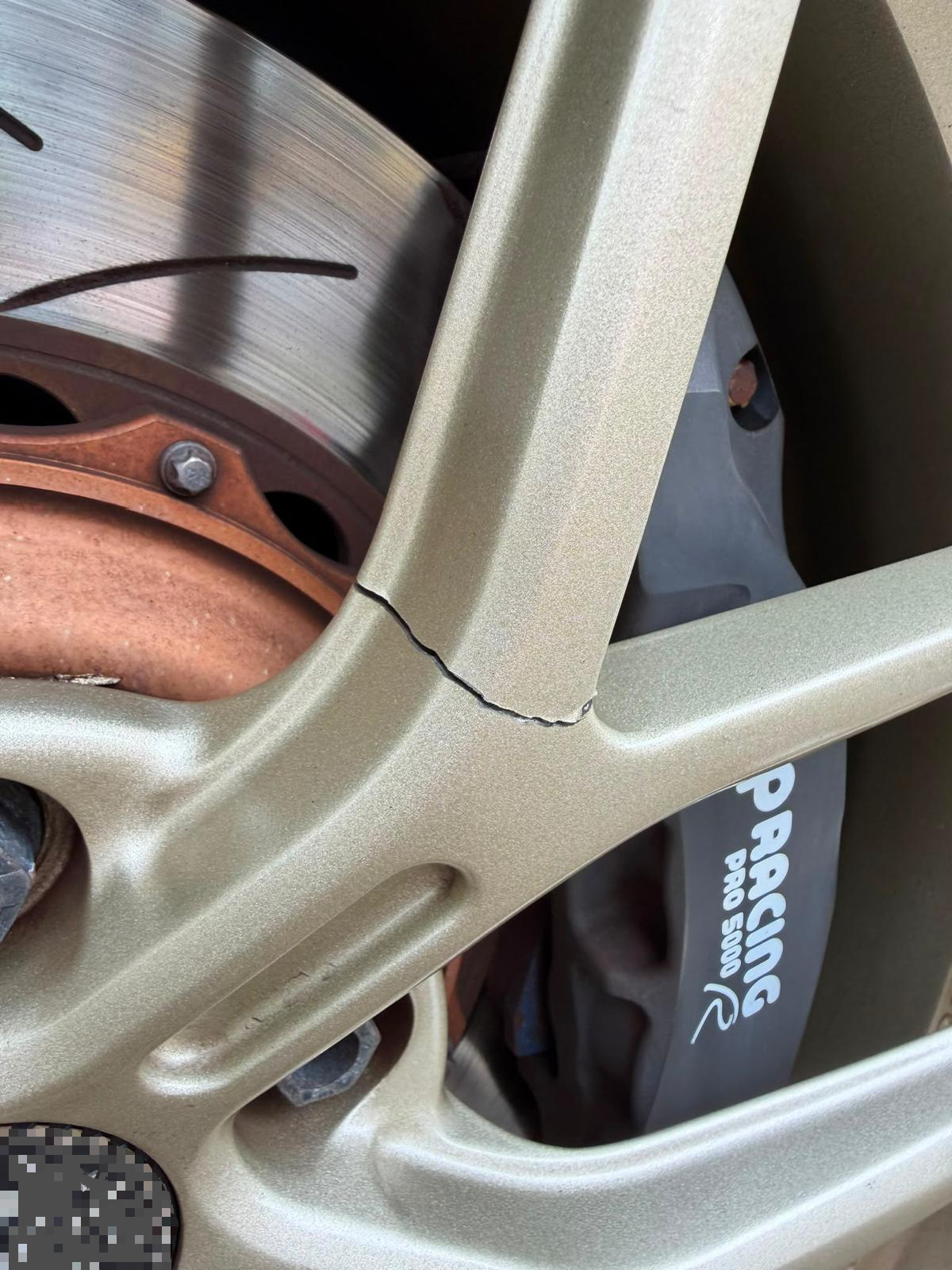
The wheel's CAD was run through LoudGears with the load case for the vehicle it was fitted to. The highest stress on the whole wheel, 139.2 MPa, landed on the inside edge of the fork root, at the crack origin. It is above the fail line of about 104 MPa, a third of the 313 MPa yield strength used for 6061-T6.
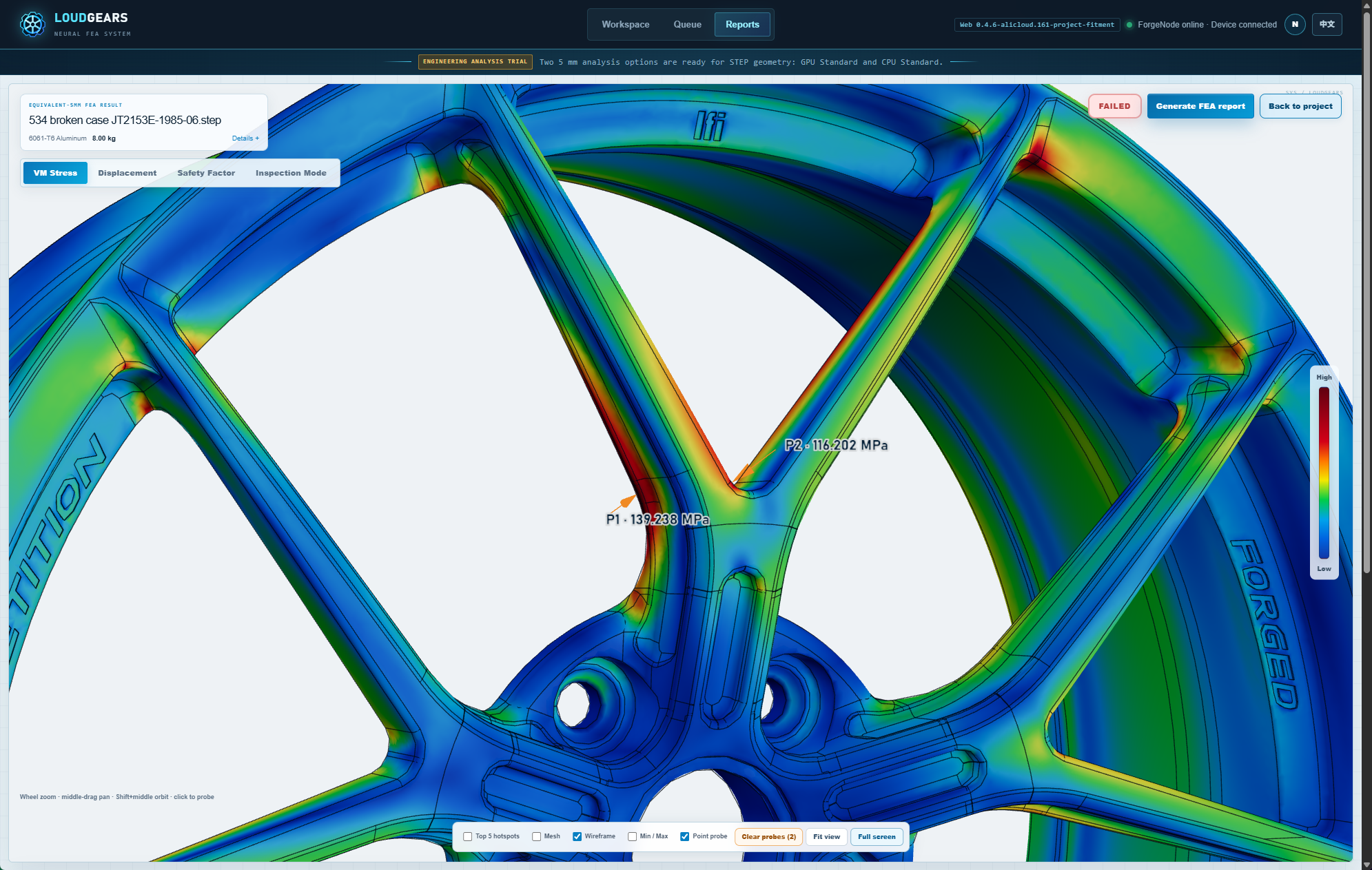
The partner revised the design in two places. The fork-root fillet radius was increased, so the load turns the corner gradually instead of piling up at a tight inside edge. The spokes were made thicker, so the same load spreads over more metal. A design with the original hotspot would not pass a release check at a safety factor of 3.0.
Case 02: a spoke edge and a bridge
The second wheel, also 6061-T6, cracked in two places in road use: along the edge of a slim spoke, and at a small bridge joining two spokes near the hub.
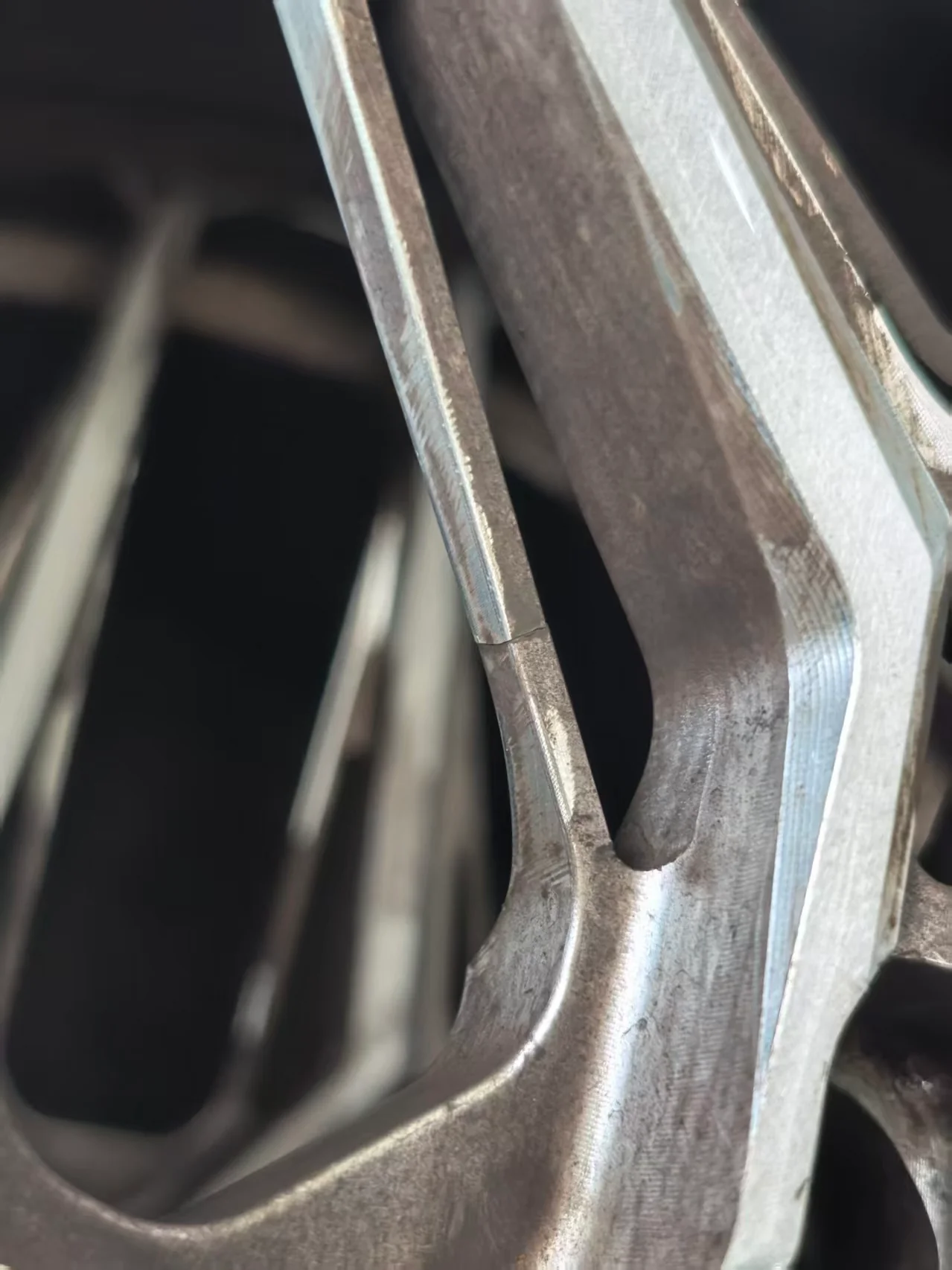
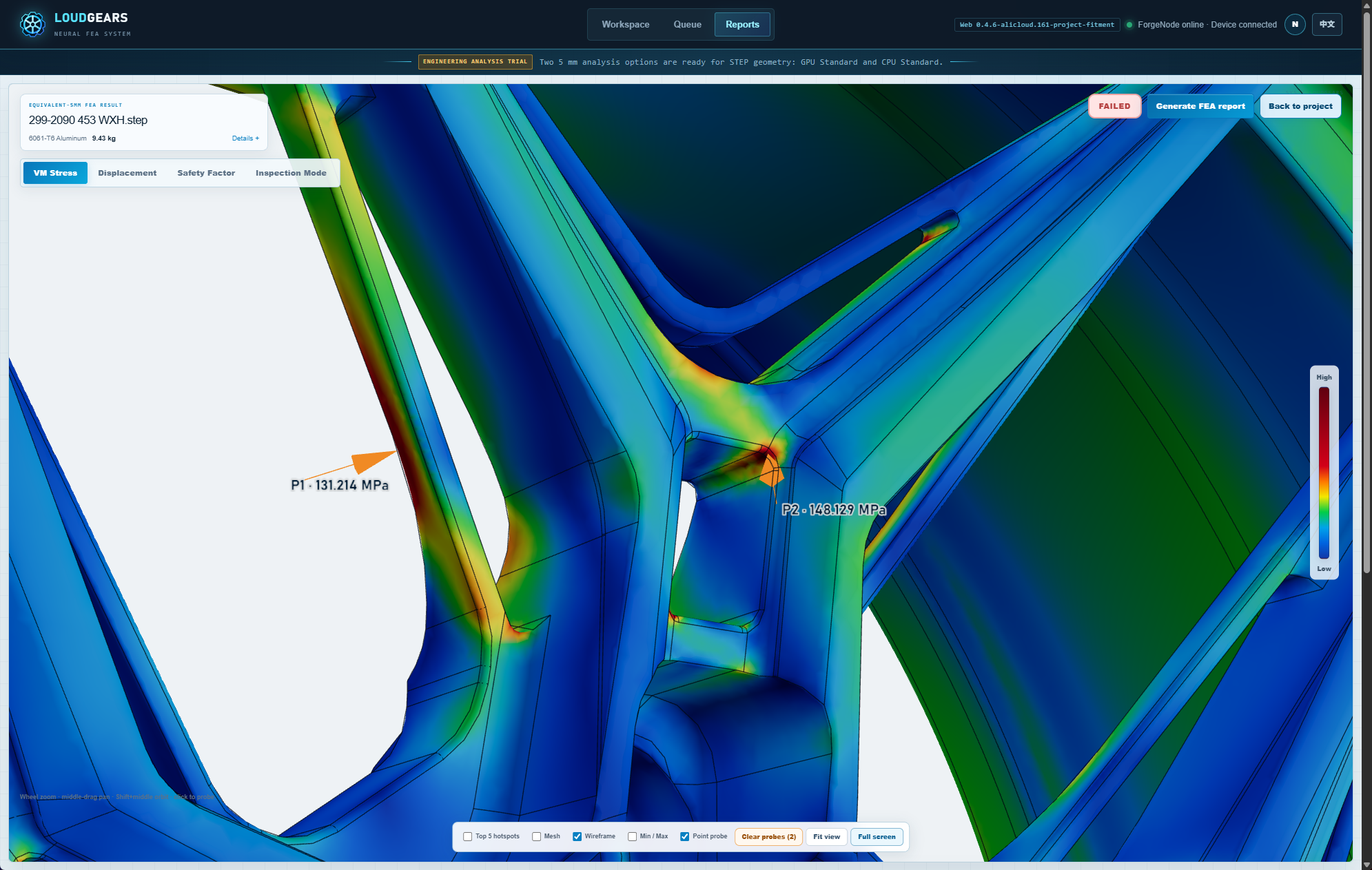
LoudGears found two hotspots: 131.2 MPa on the spoke edge and 148.1 MPa on the bridge. Each sits on one of the cracks. The bridge is the worse of the two. It is a thin link between two stiff spokes, so when the spokes flex against each other under torque, the bridge takes the strain.
Below yield, above the limit
The part that surprises people is how low these stresses are compared with the alloy's strength. None of the hotspots comes close to the 313 MPa yield strength. In a single hard hit, neither wheel would have bent. They cracked anyway.
| Hotspot | Peak stress | Safety factor | Above the 104 MPa fail line | Share of 313 MPa yield |
|---|---|---|---|---|
| Case 01, fork root | 139.2 MPa | 2.25 | about 33% | about 44% |
| Case 02, spoke edge | 131.2 MPa | 2.39 | about 26% | about 42% |
| Case 02, bridge | 148.1 MPa | 2.11 | about 42% | about 47% |
A wheel goes through its load cycle every time it corners, brakes or crosses a joint in the road, millions of times over its life. At under half of yield, repeated often enough, aluminium fatigues. A crack starts at the most stressed corner and grows a little on each cycle. That is why the release line sits at a safety factor of 3.0: the margin is there for fatigue, not for one big hit.
What the model was and was not told
For both replays LoudGears was given the wheel geometry, the material and the vehicle load case. It was not told where either wheel had cracked. The hotspots are what the solve found, and they line up with the cracks on both wheels.
Two cases are not a guarantee, and they should not be read as one. Explaining a failure after the fact is easier than predicting one. What the match does show is that a load case built from radial load and wheel torque puts the stress where real roads put it. A simulation that only pushes down on the wheel could have missed both. For an example of exactly that, see radial vs combined load FEA, where a spoke-root groove passed a radial-only check and failed once the other loads were added.
Design rules for spoke roots
For brands and design teams, the practical lessons are simple to state and easy to forget under styling pressure.
- Look at the root, not the spoke. A thick spoke with a tight corner at the hub can be weaker than a slim one with a generous fillet.
- Treat thin bridges and hub-side grooves as suspects. They look light and technical, and unless the stress map clears them they are often where the wheel cracks first.
- Ask where the peak is, not only what it is. A safety factor tells you the margin. The location tells you whether the weakest point is somewhere a crack would matter.
- Re-check after styling changes. Grooves, engraving, window edges and machined accents near the root all change local stress. Run the same load case again.
- Fix it locally first. When a spoke root fails, the usual fixes are a larger fillet radius and more spoke depth or width. LoudGears' rule-based Design Advisor points to these by location, and every change still needs a new run and an engineer's review.
What to tell your customers about inspection
Both cracks in this article were visible before anything worse happened. That makes inspection guidance worth including with every set of wheels you sell. After a hard pothole, a kerb strike or a track day, and whenever the tyres are off:
- Clean the back of the spokes and the area around the hub, where brake dust hides detail.
- Look along each spoke root, fork and bridge for a fine line in the paint or a line that collects dirt.
- If a line is found, the wheel should come off the car and be checked. A root crack does not stop growing on its own.
For the other ways wheels fail, see wheel failure modes explained.
What FEA does and does not promise
A design that clears a safety factor of 3.0 at every hotspot has been checked, with margin, for the vehicle's loads before it is made. It is still a design check, not a certification or a fatigue-life figure. Kerb strikes, severe potholes and track abuse can damage any wheel, and physical tests such as JWL apply only to the specification tested.
To see how hotspots are labelled on a real result, open the demo.